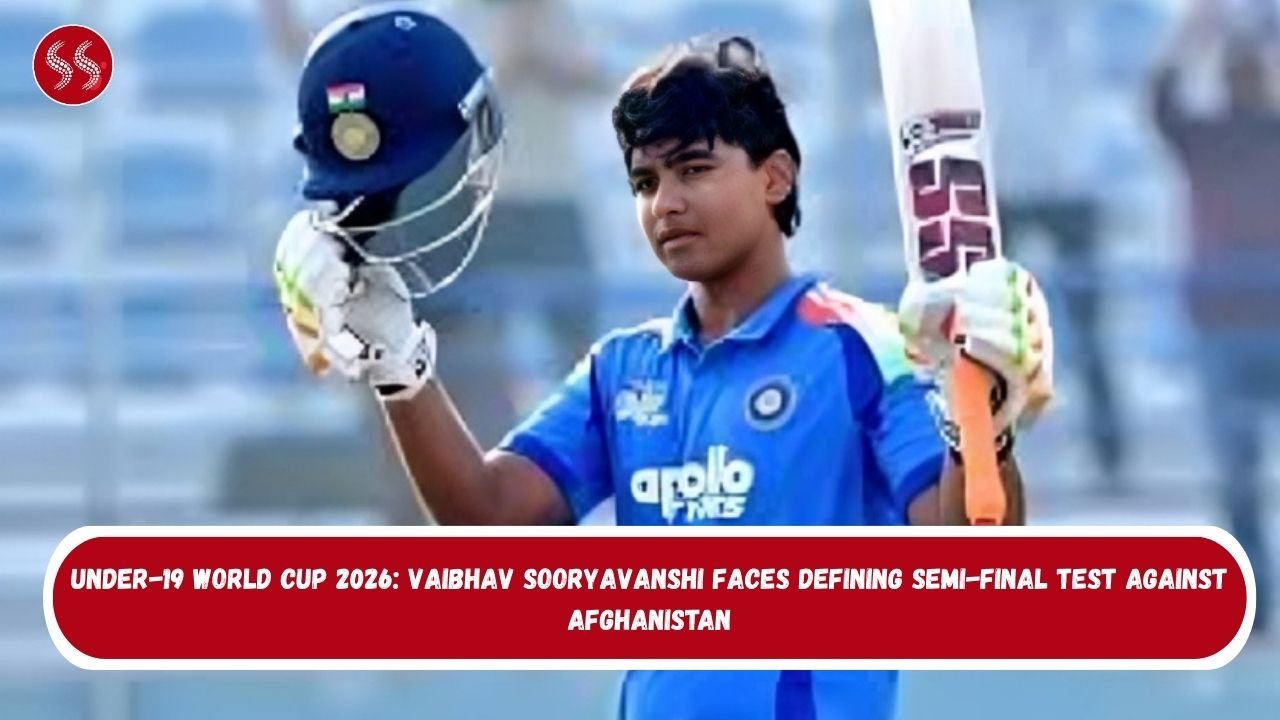

Expectations are inseparable from elite sport, especially when a prodigious talent emerges early. At the Under-19 World Cup 2026, Vaibhav Sooryavanshi arrived as one of India’s most talked-about batters, burdened and buoyed by the promise of greatness. Five matches into the tournament, the 14-year-old left-hander has delivered flashes of quality without yet producing the one innings that fully justifies the hype surrounding him at the Under-19 World Cup 2026.
Sooryavanshi’s scores — 30, 52, 40, 72 and 2 — underline a campaign rich in starts but short on domination. As India prepare for a high-stakes semi-final against Afghanistan in the Under-19 World Cup 2026, he remains an intriguing subplot rather than the central figure many expected. Talent has never been the question; translating it into match-defining impact is the challenge that still lies ahead at the Under-19 World Cup 2026.
ALSO READ:
Flashes of brilliance, search for control
There have been moments that remind observers why Vaibhav Sooryavanshi is rated so highly. His 72 against Bangladesh was a study in composure, arriving when India were wobbling at 53/3. That innings, crafted during the Under-19 World Cup 2026, blended aggression with responsibility — six fours, three sixes, and a notable emphasis on singles that reflected a maturing understanding of tempo. It was a knock that stabilised the innings and hinted at his ability to anchor when required.
Similarly, the 52 against Zimbabwe carried the promise of something bigger. Having settled in, Sooryavanshi looked poised to take control before a soft dismissal cut short his stay. The pattern has repeated itself through the Under-19 World Cup 2026: strong beginnings, followed by lapses that prevent him from batting deep. Quickfire 30s and 40s have helped India, but they have also shifted responsibility to the middle order more often than planned in the Under-19 World Cup 2026.
What stands out is not a lack of skill, but a question of judgement. Sooryavanshi consistently reaches promising positions; knowing when to consolidate and when to accelerate remains his unfinished lesson at the Under-19 World Cup 2026.
A recurring weakness under scrutiny
A closer look at his dismissals reveals a clear trend. All five have come against pace, frequently via short or hard-length deliveries. Three times, the pull shot has proved his undoing — mistimed rather than misguided, suggesting instinct overpowering calculation. Even in his longer knocks at the Under-19 World Cup 2026, the endings have arrived when a set batter was expected to push on.
The semi-final against Afghanistan sharpens that test. Knockout matches in the Under-19 World Cup 2026 amplify pressure, demanding clarity of thought and disciplined shot selection. Afghanistan’s bowling attack thrives on control rather than raw speed, led by right-arm seamer Nooristani Omarzai, who tops their wicket charts. Supported by Khatir Stanikzai, Wahidullah Zadran and Abdul Aziz, they are likely to probe Sooryavanshi with consistent hard lengths, challenging his patience.
Opportunity on the biggest stage
For India, the expectation is not reckless aggression. Raised in a T20-heavy environment, Sooryavanshi’s instincts lean towards impact, but the semi-final of the Under-19 World Cup 2026 calls for something more measured. A substantial innings — one that lasts deep and shapes the contest — would ease the burden on the middle order and underline his readiness for pressure situations.
Wednesday’s clash represents opportunity rather than burden. The Under-19 World Cup 2026 has already showcased Sooryavanshi’s talent in bursts; what it still awaits is an innings that marries flair with restraint on the grandest youth stage. Whether that moment arrives against Afghanistan could influence India’s route to the final and define Sooryavanshi’s journey through the Under-19 World Cup 2026.
SEE MORE: